Neighborhood Intelligence
Clyde Hill, Washington
Where hilltop views meet downtown proximity. A market in transformation—rapid appreciation, new construction wave, and the Eastside's best value proposition above $4 million.
Clyde Hill is a city in transformation. Once a quiet, largely underdeveloped hillside community between Bellevue and the Lake Washington shoreline, it has become one of the Eastside's most dynamic real estate markets—a place where elevation creates views, views drive value, and new construction is reshaping the streetscape at an unprecedented pace.
Unlike Medina, which is defined by waterfront exclusivity, or Hunts Point, which is a more established luxury enclave, Clyde Hill operates on different rules. There are roughly 900 residential parcels in the city—far more than in any of the other premium Eastside communities. Lot sizes are smaller, averaging 0.3 to 0.5 acres. And the market moves faster, with significantly higher transaction velocity and less of the private-sale culture that characterizes its neighbors.
For buyers, this creates opportunity. Clyde Hill offers premium Eastside addresses, exceptional views, direct proximity to downtown Bellevue (literally walking distance to The Bravern and Lincoln Square), and increasingly, turnkey new construction—all at lower entry prices than Medina. For sellers, it means a more active buyer pool and market conditions that tend to reward clarity of positioning.
This guide is written from direct market experience in Clyde Hill over two decades. It addresses what the market data says, what it doesn't say, and how to approach buying or selling in a community that is fundamentally different from the other ultra-premium neighborhoods on the Eastside.
The Market: Higher Volume, Faster Movement, Strong Appreciation
As of early 2026, the median sale price in Clyde Hill stands at approximately $6.4 million, with a meaningful range dependent on views, elevation, lot size, and construction type. Over the past two years, Clyde Hill has consistently outperformed both Medina and broader King County in price appreciation—a phenomenon driven by three factors: high transaction volume (providing real data on value), new construction supply (raising the floor on pricing), and the view-premium that has concentrated buyer demand.
What distinguishes Clyde Hill's market from its peers is velocity. Where Medina typically sees 5–8 sales per quarter, Clyde Hill regularly sees 15–20. This higher volume means less ambiguity about pricing. The market establishes comps quickly and consistently. It is harder to overprice, but it is also easier to sell if you are positioned correctly.
Average days on market in Clyde Hill has compressed to approximately 24 days for homes priced realistically in the $5M–$8M range. Homes that sit longer are typically: overpriced relative to comparable views and land, positioned poorly (lifestyle or condition issues not offset by location), or in lower-demand micro-zones. The bifurcation that exists in Medina—between quick sales of well-priced homes and extended holds for overpriced ones—is more pronounced in Clyde Hill because there is more inventory competing for the same buyer pool.
Appreciation data is compelling. Homes that sold in Clyde Hill in 2022–2023 for $4.2M–$5.2M in comparable locations are trading in the $5.4M–$6.5M range today. This 20–25% appreciation in three years exceeds broader market performance and reflects both the strength of the premium market and the unique characteristics of the Clyde Hill micro-geography.
The Role of the MLS in Clyde Hill
Unlike Medina, where private sales and pocket listings dominate, Clyde Hill is an MLS-driven market. Approximately 80–85% of Clyde Hill transactions appear on the MLS; off-market sales exist but are far less prevalent than in neighboring communities. This means that browsing the public listings gives you a much more complete picture of what is actually selling in Clyde Hill.
For buyers, this transparency is an advantage—you can see genuine market data and identify patterns. For sellers, it means less opportunity to hide pricing from competition. The solution is not to avoid the MLS but to understand that any pricing advantage must come from genuine differentiation: superior views, better condition, smarter positioning, or a property that fills a specific buyer need.
Geography & Elevation: Why Views Are the Value Multiplier
Clyde Hill sits on an elevation significantly higher than Bellevue's downtown core. This geography is the single most important feature of the market. From the right locations—primarily at the higher elevations in central and east Clyde Hill—you can see Lake Washington to the west, the Cascade Range to the northeast, the Olympic Range to the west-northwest, and on clear days, Mount Rainier to the south.
View corridors drive pricing in Clyde Hill far more dramatically than they do in most other markets. A home with fully exposed, unobstructed views of Lake Washington and the Cascades will trade at $1.2M–$2M higher than an architecturally identical home two blocks away with no views. This is not proportional to the home's square footage or lot size. It is a function of scarcity—truly exceptional views exist on a limited number of lots, and the buyer pool for such views is deep and committed.
Unlike Medina, where waterfront status is the primary determinant of value, Clyde Hill has no waterfront. View corridors replace waterfront as the wealth driver. This distinction is important for buyers evaluating Clyde Hill against Medina. If waterfront is essential to you, Clyde Hill is not the right choice. If panoramic hillside views, proximity to downtown Bellevue, and turnkey contemporary new construction are more important, Clyde Hill often represents superior value.
Understanding View Quality and Permanence
Not all views are equal. A view that consists of a sliver of Lake Washington between two trees is categorically different from a view where the lake dominates the western prospect. Similarly, views from interior lots that face downhill toward Bellevue or across the foothills are valuable in their own way but trade at significantly lower premiums than views of major geographic features—the lake, the Cascades, Mount Rainier.
For buyers, the critical due diligence question is: how permanent is this view? Clyde Hill has no view-protection ordinance. A neighbor's landscaping changes, new construction on lower-elevation lots, or tree growth can compromise or eliminate views over time. Before purchasing any Clyde Hill home where views represent a substantial portion of the value proposition, you should: document the view through photos and video, understand setback requirements and height restrictions on adjacent properties, review the neighbor's land position and any development history, and consider engaging a surveyor or view consultant to assess the view's durability.
The New Construction Wave: 40% of Homes Above $5M Are Newly Built
The most visible change in Clyde Hill over the past five years has been the teardown-and-rebuild phenomenon. Approximately 40% of homes selling above $5 million in Clyde Hill are new construction, compared to roughly 15–20% in Medina and perhaps 25% in Hunts Point. This is not a minor trend—it is reshaping the community's architectural character.
The economics are straightforward: a mid-century home on a 0.4-acre lot in a good view corridor might command $3.5M as a renovation candidate, but a newly built, 5,500-square-foot contemporary home with open floor plans, high-performance systems, and optimized view glass on the same lot can sell for $5.8M–$6.8M. For developers and sophisticated builders, this spread creates compelling economics.
What this means for the market: First, expectations for condition have risen. A 1970s home requiring $1.5M in updates is now competing against new builds that require nothing. Sellers of older homes must either invest in significant renovation or accept that they are selling to renovation-ready buyers at lower prices. Second, the new construction wave has accelerated absorption of higher price points. The psychological barrier to $6M that existed a decade ago has been normalized—buyers are increasingly comfortable with new-construction price tags in that range because the alternative is a $3.5M older home that will require 18 months of work.
For buyers, new construction in Clyde Hill offers appealing certainty: no surprise structural issues, modern systems with builder warranties, design optimized for contemporary living, and no renovation timeline risk. The trade-off is lack of land maturity—newer homes often have less established landscaping and smaller trees, which can affect privacy and the sense of settled residential character that older homes sometimes provide.
Architecture: Mid-Century Roots, Contemporary Reshaping
Clyde Hill's residential stock reflects several distinct eras. The oldest homes date to the 1950s and 1960s—ranch-style, split-level, and early modern designs that took advantage of the elevation for views. Many of these homes were built on speculation by local builders without the architectural caliber of homes in contemporaneous Medina, but they have aged well in many cases and remain solid houses with good bones.
By the 1980s and 1990s, Clyde Hill filled in with larger homes—transitional and traditional styles, often 4,000–6,000 square feet, built on speculative homesites. These homes are the current bulk of inventory on the market in the $4M–$5.5M range, and many are candidates for renovation or rebuild depending on structural condition and view potential.
The contemporary wave—homes built in the past five years—represents the new aesthetic standard. These are typically 5,000–7,000+ square feet, designed for open living, with walls of glass oriented to maximize views, clean-lined interiors, high-end systems, and architectural language that emphasizes simplicity and craftsmanship. Architects and builders working in Clyde Hill have learned to design for the views—full-height glass on the western exposure, open kitchens and living rooms on view-facing sides, and master suites positioned to enjoy the panorama.
For buyers, this architectural range creates choice. If you want a turnkey home that requires no work and was designed for current living, new construction is abundant and actively marketed. If you want a home with mature landscaping and a more established sense of place, older homes offer that at lower prices—assuming you are prepared for renovation. The choice is not about quality but about priorities and risk tolerance.
Schools: Bellevue School District Excellence
Clyde Hill falls within the Bellevue School District, and schools are a primary driver of decision-making for families with children. The district is one of the highest-performing in Washington State, and the specific schools serving Clyde Hill are excellent choices.
Clyde Hill Elementary
Clyde Hill Elementary serves grades K–5 and is noted for strong academics, active parent involvement, and a cohesive community feel. Located in the heart of the city, it provides walkability for many families. The school emphasizes both traditional academics and arts programming, and parent engagement is notably high. For families in the west and central parts of Clyde Hill, Clyde Hill Elementary is a primary draw.
Chinook Middle School
Chinook Middle School (grades 6–8) serves Clyde Hill and several neighboring areas. It is recognized for strong academics, particularly in STEM, and maintains selective honors and Advanced Learning programs. Clyde Hill residents attending Chinook typically go on to Bellevue High School.
Bellevue High School
Bellevue High School (grades 9–12) is among the highest-performing public schools in Washington State and in the nation. It serves Clyde Hill, Bellevue, and surrounding communities. Strong academics, excellent athletics, and a culture of achievement make it a primary attractor for families in the premium Eastside communities. Students consistently earn national recognition in academic competitions and arts.
Private School Access
Clyde Hill's proximity to Bellevue means families have quick access to the region's leading independent schools: Lakeside School (one of the most selective in the nation, 15–20 minute commute), Bellevue Christian, The Bush School, and University Prep. Several are a 10–15 minute drive from most Clyde Hill locations.
Clyde Hill's Micro-Zones: Where Pricing and Character Vary Most
Like any city of roughly 900 parcels, Clyde Hill has distinct micro-areas. Understanding these zones clarifies both pricing logic and buyer profile. The elevation and view access define each zone's character more than any other factor.
West Clyde Hill / Points Drive Area
The western edge of Clyde Hill, including areas near Points Drive and the western boundary, is closer in character to Medina and Bellevue. This zone is most accessible by elevation (less steep terrain) and borders downtown Bellevue closely. Homes here tend to trade in the $4.5M–$7.5M range depending on views. Some homes in this area have views toward the lake; others look primarily toward Bellevue and the foothills. The zone attracts buyers who prioritize proximity to downtown Bellevue amenities over dramatic elevation-driven views.
Central Clyde Hill / 92nd Avenue Corridor
The central core of Clyde Hill, along and near 92nd Avenue, is where the market volume concentrates. This zone includes the highest density of residential parcels, the most active new construction, and homes trading across a wide range—$4.2M to $8M+. Elevation here is moderate to high, and view opportunities are abundant. This is where you find the greatest architectural diversity, the most active turnover, and the widest price range. For buyers with specific priorities (certain view exposure, proximity to a school, architectural preference), the central zone offers the most options.
East Clyde Hill / Bellevue Border
The eastern edge of Clyde Hill, closest to Bellevue city proper, includes some of the highest elevations and the most dramatic views of the Cascades and Lake Washington. Homes here are among the most expensive in Clyde Hill, often $6.5M–$12M+, and they are typically newer construction designed specifically to maximize eastern and western views. The terrain is steeper here, which limits lot density but creates more exclusive positioning. This is the zone for buyers who prioritize panoramic views over convenience or who are specifically seeking new construction at the premium tier.
North Clyde Hill / SR-520 Corridor
The northern tier of Clyde Hill, closest to the SR-520 bridge, represents the most accessible entry point to the city in terms of price. Homes here tend to trade $3.5M–$5.5M and are more likely to be in need of renovation or refresh. Elevation is lower here relative to central and east Clyde Hill, which affects view opportunities. This zone attracts buyers who value the Clyde Hill address and school access but have more limited view expectations or are specifically seeking renovation opportunities on lower price points.
Clyde Hill Market Snapshot: Key Metrics
| Metric | Current (Q1 2026) | Year Ago |
|---|---|---|
| Median Sale Price | $6.4M | $5.8M |
| Median Listing Price | $6.9M | $6.2M |
| Average Days on Market | 24 days | 38 days |
| Active Inventory | ~48 homes | ~52 homes |
| Price Range (Primary Tier) | $4.5M–$8M | $4.2M–$7.2M |
| New Construction Share (5M+) | ~40% | ~30% |
| Total Residential Parcels | ~900 | ~900 |
Sources: NWMLS, King County Assessor, proprietary transaction data. New construction estimates based on direct market observation and county building records. Data updated quarterly.
Community Character: Active, Growing, Contemporary
Unlike Medina, which is characterized by quiet insularity, Clyde Hill feels like a city in the process of becoming. New homes are visible in various stages of completion. The streetscape is evolving. The community is more diverse in character and less homogeneous in architectural expression than Medina, which appeals to certain buyers and may feel less cohesive to others.
Clyde Hill is an incorporated city with its own municipal government, though it operates more openly and with more accommodating development policies than Medina. Short-term rentals are allowed with limitations. Commercial activity is minimal but not entirely prohibited at the edges. The overall sensibility is one of planned residential growth rather than preservation of a fixed past.
The city's direct proximity to downtown Bellevue (literally walking distance from the eastern edge to The Bravern shopping center and Lincoln Square office development) creates a different lifestyle than Medina. Residents can access fine dining, retail, and services on foot in some areas. Recreation is abundant—the city maintains multiple parks, and access to the Mercer Island and Bellevue trail systems is immediate.
Property crime in Clyde Hill is low. Traffic congestion exists during peak commute hours, particularly on 92nd Avenue. The neighborhood is quieter than urban Bellevue but more active than Medina. For buyers seeking a premium address close to urban amenities without the full intensity of living in Bellevue proper, Clyde Hill offers an appealing middle ground.
Financial Considerations: Taxes, Appreciation, and Long-Term Value
Washington State's lack of income tax remains a powerful attractor for high-earning buyers relocating from other states. This single factor has supported the premium Eastside market for decades and continues to drive interest in Clyde Hill specifically.
Property taxes in Clyde Hill run approximately 0.85–1.0% of assessed value, assessed through King County. For a $6.4M home with market appreciation factored in but assessed values lagging, property taxes typically range from $28,000 to $42,000 annually, depending on specific parcel history and levy amounts. Homes in the $8M+ range may see property tax bills approaching $50,000–$65,000 annually.
Sellers should understand Washington's Real Estate Excise Tax (REET), which is tiered from 1.1% to 3.0% based on sale price. On a $6.4M sale, REET can reach $160,000–$192,000—a material cost that must be factored into any net proceeds analysis. Washington does not tax capital gains from primary residences, which provides significant benefit for long-term owners selling at substantial appreciation.
Clyde Hill's appreciation over the past three years has been notably strong—approximately 20–25% on homes purchased in the $4.2M–$5.2M range in 2022–2023. This appreciation reflects both general market strengthening and the specific supply-demand dynamics of the new construction wave. Homes designed for contemporary preferences and optimized for views have appreciated faster than older homes in less-desired micro-zones.
Buying Strategy: Finding Value and Avoiding Pitfalls in a Fast Market
Buying in Clyde Hill differs meaningfully from buying in Medina. The higher inventory, faster market velocity, and greater reliance on the MLS mean that a more active, data-informed approach works well. Passive browsing is less risky in Clyde Hill than in Medina because you are seeing the actual market—but it also means that opportunity windows are tighter and competition for well-positioned homes is intense.
The buyers who succeed in Clyde Hill typically: (1) know what price tier they are in and what that price delivers in terms of size, views, condition, and location; (2) have clear micro-zone preferences and understand why (downtown Bellevue proximity vs. dramatic views vs. school access); and (3) move quickly when they find the right property, because market absorption for well-priced homes is fast.
Key due diligence items specific to Clyde Hill: view durability (as discussed above), property tax assessment accuracy (older parcels are often underassessed, but assessments change with sales), new construction warranty coverage (if buying a recent build), and subdivision/lot history (some properties in Clyde Hill have complicated title or easement issues stemming from older development patterns).
Timing in Clyde Hill is somewhat more predictable than in Medina—the spring and early fall are active seasons. Q4 and Q1 typically have lower inventory and less competition. If you have flexibility on timing, approaching Clyde Hill in Q4 may offer a better buyer's market than late spring.
Selling Strategy: Clarity, Positioning, and Realistic Pricing
The fundamental difference between selling in Clyde Hill versus Medina is transparency. In Medina, you can sometimes create information asymmetries—what the market doesn't know, the seller's agent can sometimes control. In Clyde Hill, the market knows. Comparable sales are published, absorbed quickly, and buyers are sophisticated enough to understand pricing patterns by micro-zone and view tier.
This means selling strategy in Clyde Hill emphasizes clarity and positioning over information control. The most successful Clyde Hill sales are those where the seller understands and articulates the property's specific strengths: the view exposure, the architectural quality, the renovation status, the school access, the micro-zone advantage. Marketing that emphasizes these genuine differentiators outperforms generic luxury positioning.
For homes in the $3.8M–$5.2M range, MLS exposure is typically the right strategy. This price tier has the most inventory and the most active buyer pool. For homes in the $6M+ range, particularly if they are new construction, a marketing strategy that includes architect/designer credit, publication in design-focused media, and targeted outreach to builders and designer-focused buyer networks often outperforms pure MLS strategies.
Pricing discipline is non-negotiable in Clyde Hill. Homes priced within 3–5% of true market value sell in 18–30 days. Homes priced 10%+ above market can sit for 90+ days. The data is too transparent for other strategies to work. The best approach is: price realistically from day one, market strongly, and prepare for a quick sale from a motivated buyer pool.
New Construction in Clyde Hill: Opportunities and Considerations
The prevalence of new construction in Clyde Hill creates unique opportunities and risks. On the opportunity side: new homes eliminate renovation risk, come with builder warranties, and are designed for contemporary living with optimized view glass and open floor plans. On the risk side: newer homes command premium prices, have less established landscaping, and may have less "sense of place" than homes in established settings.
For buyers considering new construction, the key questions are: Is the builder established and reputable? Are the warranties comprehensive and transferable? What is the quality of the design and material selections? How is the home oriented relative to views and neighbors? Have you verified that all permits are current and the build is on schedule? A 20% premium over a comparable older home is often justified if the build quality and design are genuinely superior. A 40% premium requires careful analysis.
Builders active in Clyde Hill range from major regional firms to boutique custom builders. The best new construction represents a genuine improvement over what older homes offer—not just newness, but thoughtful design, superior materials, and genuine lifestyle upgrades. When evaluating a new-construction project, spend time understanding whether those genuine upgrades justify the premium you are paying relative to a well-renovated older home.
Start with a Conversation About Clyde Hill
Whether you are buying, selling, evaluating specific micro-zones, or trying to understand new construction versus renovation, a 20-minute conversation with someone who has worked this market for two decades is the most efficient first step.
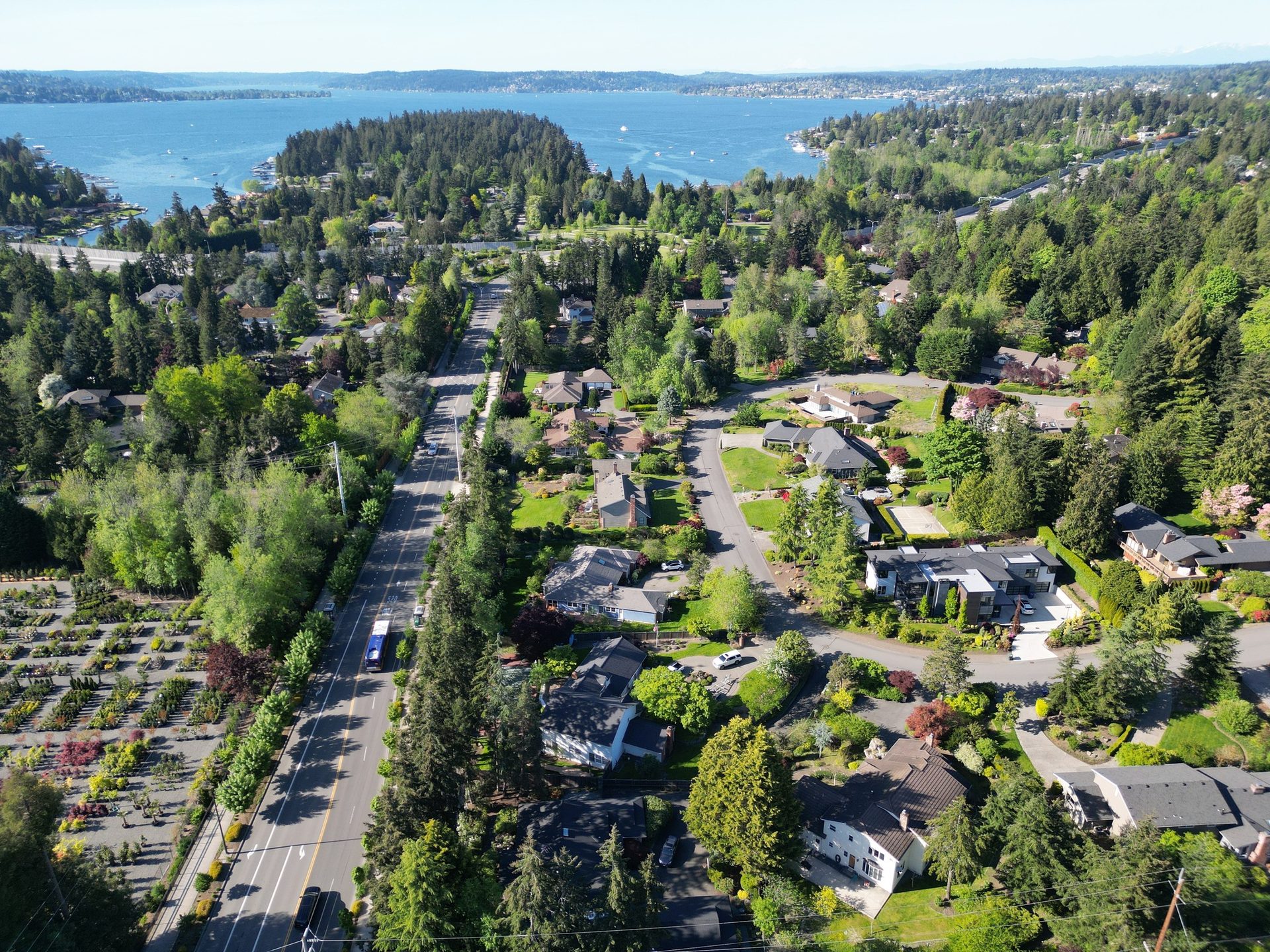
Clyde Hill's elevated topography creates unobstructed views of Lake Washington, the Cascade Range, and the Olympic Mountains. The view premium drives pricing more dramatically than in any other Eastside community.